
The Japanese subculture of Gyaru has long served as a vibrant, multi-layered rebellion against the monolithic constraints of traditional beauty and societal expectations. Within this ecosystem, Hime Gyaru, or the “Princess Gal,” represents the most structurally complex and aesthetically uncompromising manifestation of feminine sovereignty. Emerging from the street-style laboratory of Shibuya and the luxury boutiques of Osaka, the Hime Gyaru movement transcends mere fashion; it is a meticulous project of visual engineering designed to reclaim the female body from the male gaze through an overwhelming accumulation of decorative signifiers.
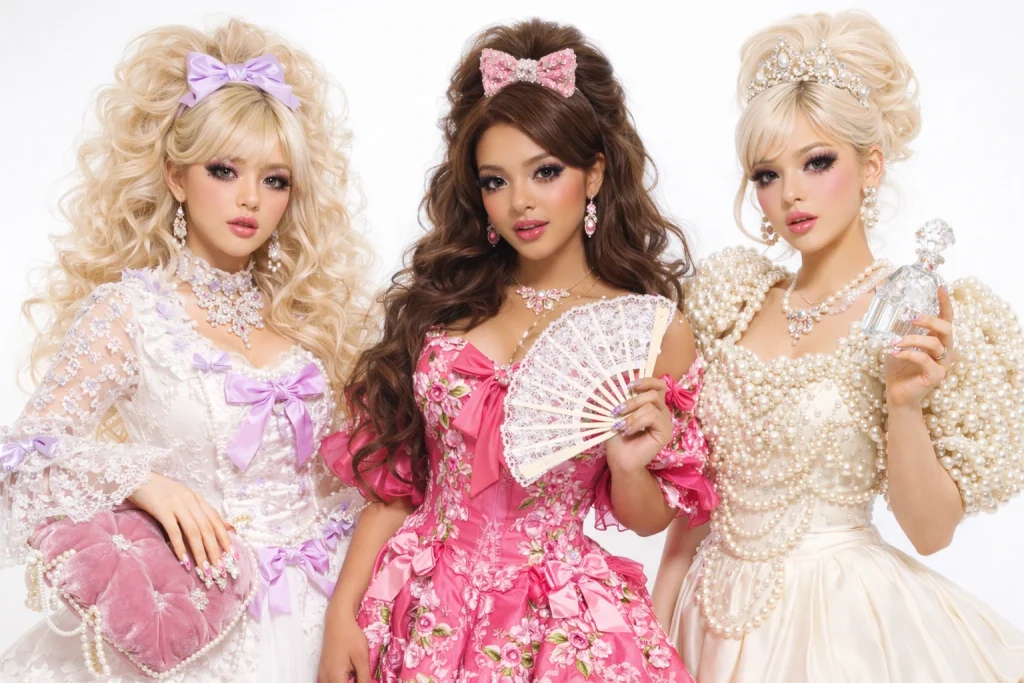
The Manifesto: A Rejection of Modern Minimalism
Hime Gyaru is not merely a fashion style; it is a calculated rebellion, an engineered fortress of femininity built to guard against the suffocating norms of modern minimalism. In an era where austere designs and muted palettes dominate, Hime Gyaru stands unapologetically against the tide. It manifests not as a “look,” but as an architectural structure of self-preservation. The visual architecture of Hime Gyaru is a celebration of excess, a maximalist response to a culture that preaches subtlety and restraint.
This subculture is an act of defiance, carving out a space where femininity is allowed to exist in its most exaggerated, opulent form. It is not enough to be pretty; to be Hime is to be a sovereign entity who wields luxury like a weapon—ornate, meticulously crafted, and untouchable.
Jesus Diamante & The Birth of Luxury: Rococo as Rebellion
At the heart of Hime Gyaru’s evolution lies Jesus Diamante, a brand that transcends fashion to define a radical new philosophy. Founded in 2001, Jesus Diamante pivoted away from the wild street aesthetics of Gyaru’s predecessors, such as the tanned, rebellious Amuraa, and instead embraced an aristocratic form of decadence. Inspired by European royalty, particularly Rococo excess, Jesus Diamante rejected the austere minimalism of the time. It became the ultimate symbol of luxury in an age when economic uncertainties plagued the youth of Japan. The brand’s commitment to hyper-feminine imagery created a cult following, with “Gals” traveling great distances to experience the ritualistic luxury of its boutiques.
Sofia Coppola’s Marie Antoinette (2006) catalyzed this shift, providing the cinematic template for the Hime Gyaru “princess” motif. Like the doomed French queen, Hime Gyaru women are meant to represent an aristocracy that does not exist in any real sense; they are heirs to a realm of excess, crowned not by blood, but by sheer will and a wardrobe of towering beauty.
Jesus Diamante’s key aesthetic—lavish rose patterns, pearls, lace, and tiaras—became the uniform of this princess rebellion, culminating in the rise of a fashion iconography that was more a statement of defiance than desire. This is not beauty for the sake of beauty. It is a loud, ostentatious rejection of an economy that stifled self-expression through minimalism.
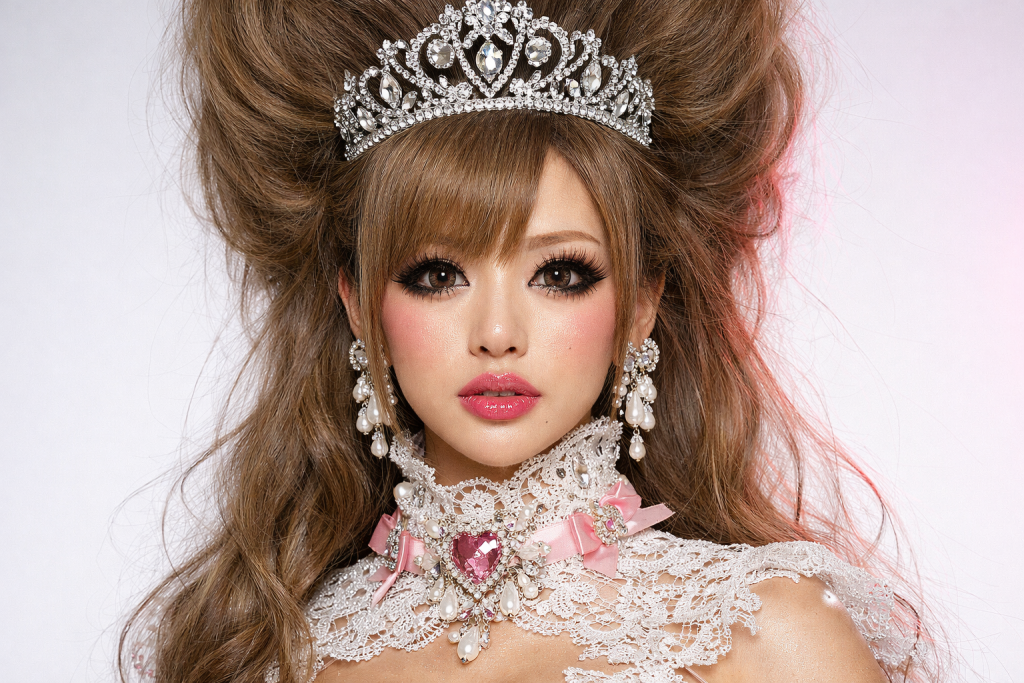
The Anatomy of Suijiki: Engineering the Beehive
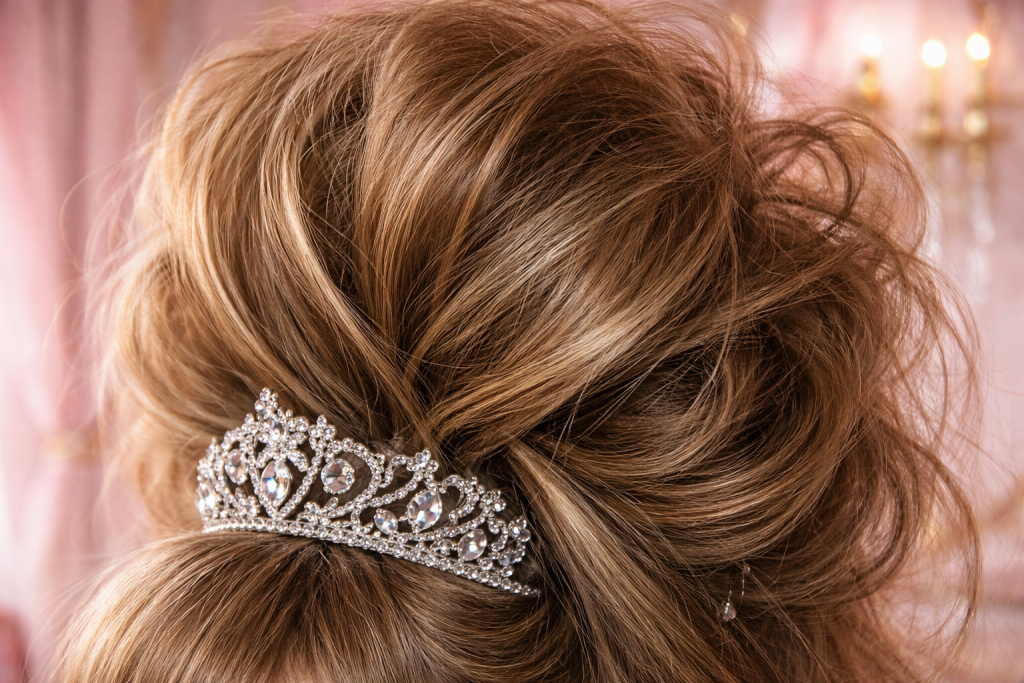
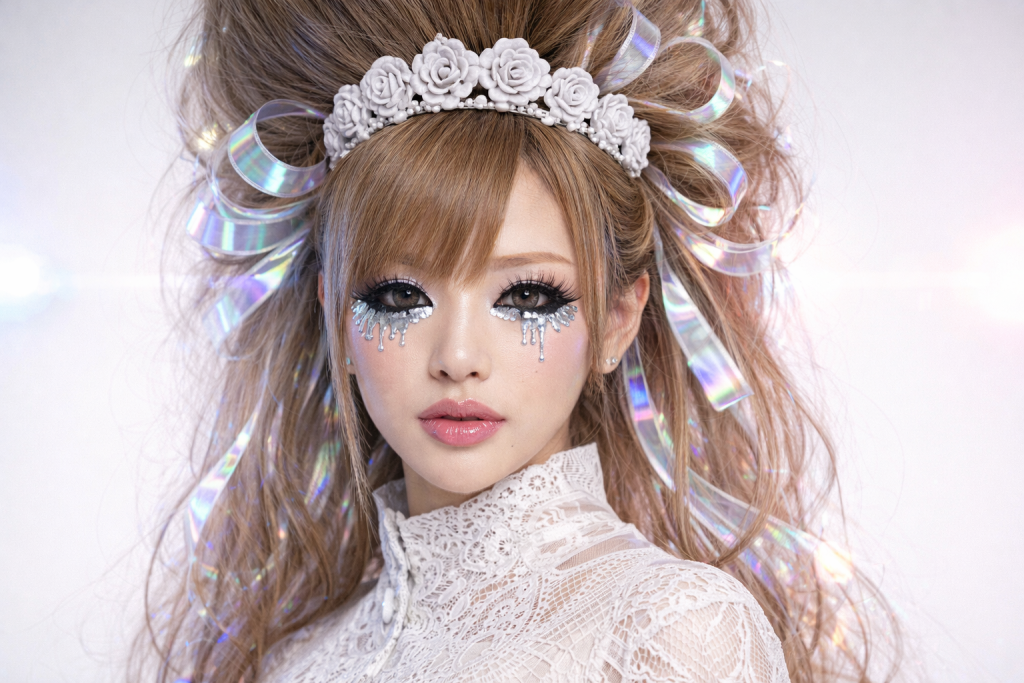
Hime Gyaru’s most recognizable feature is not simply its clothing, but its hair—a monumental construction that defies gravity and encapsulates the very spirit of the style. The height of the hair is not an accident; it is the product of meticulous engineering. Sujimori, a technique that involves building “streaks” or “ribbons” of hair, is used to achieve the beehive-like volume that defines the Hime Gyaru. This is no simple hairstyle; it is a vertical sculpture—a defiance of the natural fall of hair.
Every element of the Hime hairstyle is calculated, down to the very curl and structure of each strand. The crown of the head is teased to immense proportions, often reinforced with padding to support the structure. This becomes a visual throne for the signature tiara or oversized bow, signifying the wearer’s royal autonomy.
To maintain such a commanding silhouette, extensions are mandatory, as is the use of industrial-strength products like hair waxes and sprays. The hair’s volume is not just an aesthetic choice; it is a statement. It is about space. It is about dominating the environment. The hair does not merely sit on the head; it announces the wearer’s presence before she even speaks.
The “Busu” Defense: Reclaiming “Ugly” in an Age of Perfection
Hime Gyaru’s most radical move is the reclamation of the “Busu” (ugly) paradox. In a world obsessed with flawless beauty—whether through surgery, filters, or artificial perfection—Hime Gyaru’s embrace of the extreme “ugly-cute” aesthetic is an act of pure subversion. By turning what society deems ugly into something desirable, Hime Gyaru women assert their agency. The use of exaggerated makeup, heavy contouring, and purposely “over-the-top” accessories disassociates the style from conventional attractiveness, turning it into a powerful tool for identity construction.
Far from the dainty, porcelain-skinned ideal that has long been idolized, Hime Gyaru wears her “ugliness” with pride. She presents a beauty so exaggerated that it transcends gender and expectation. The “sweet princess” exterior is at once an armor and a shield—a rejection of traditional femininity and its role in the male gaze.
This move is a critique of both societal norms and the aspirational “clean” beauty culture that dominates the modern digital landscape. In a world obsessed with “perfect” beauty, the Hime Gyaru stands as an emblem of freedom, a refusal to be confined to societal conventions.
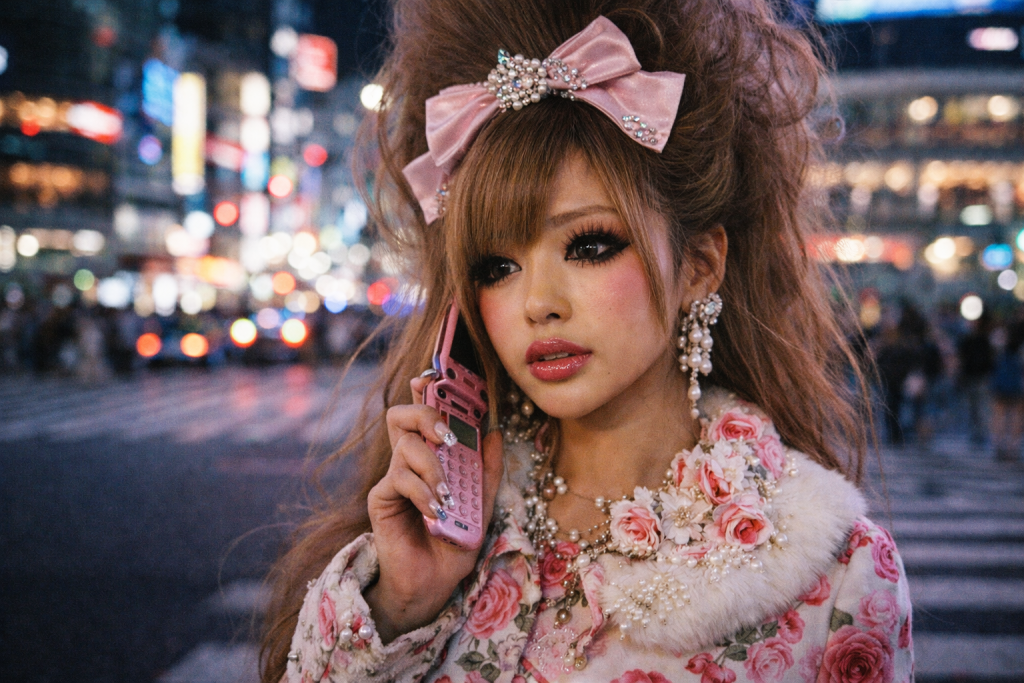
2026: The Neo-Hime Era—The Digital Renaissance
As we move into 2026, the Neo-Hime era represents the evolution of a subculture that refuses to be relegated to the past. The digital landscape has become integral to the modern Hime Gyaru’s lifestyle. The fashion, once confined to physical space, now permeates virtual worlds with digital drops—high-resolution textures for avatars, virtual planners, and even digital accessories. The fashion rebellion has transcended the physical body, blurring the lines between the real and the digital.
The Neo-Hime embodies a fusion of maximalism with digital decadence, rejecting the minimalist “quiet luxury” that dominated early 2020s fashion. Digital platforms and virtual spaces now serve as the new canvases for the Neo-Hime’s extravagant expressions. From the fusion of avant-garde beauty and glitch-inspired aesthetics to the rise of “circus core” decor and tactile 3D accessories, Neo-Hime pushes maximalism to new extremes.
In the face of digital perfectionism, the Hime Gyaru has manifested a “glitchy” beauty—one that distorts and reinterprets the ideals of femininity through a synthetic, almost alien lens. This is not the Hime of the 2000s; this is the future, a world where elegance meets chaos, and the princess reigns supreme in both the physical and virtual realms.
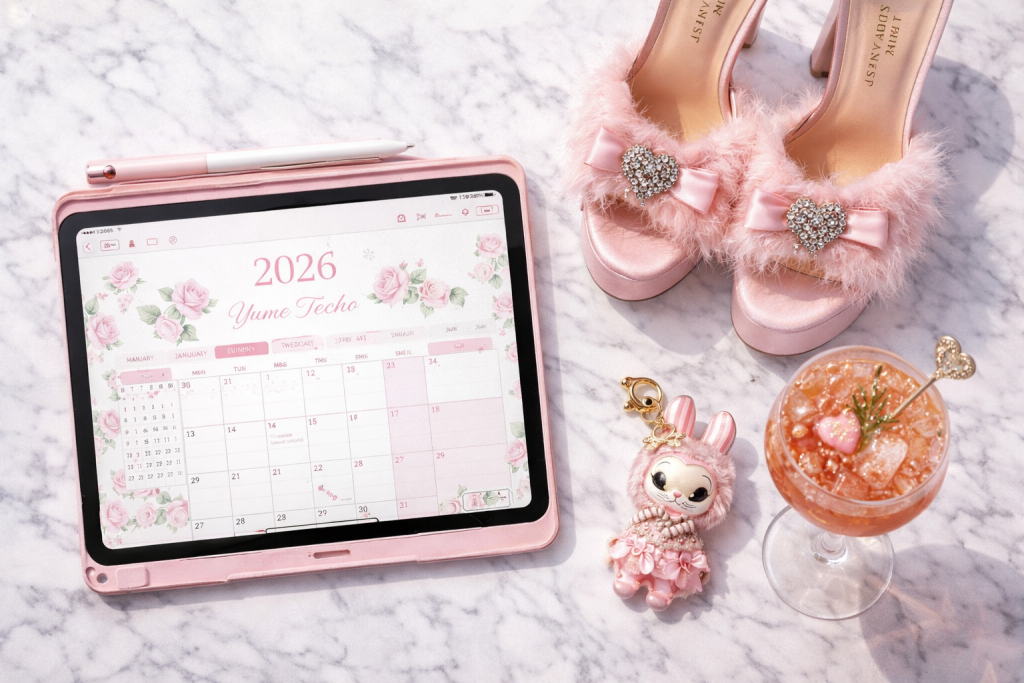
Hime Gyaru, forever uncompromising, is not a fleeting fashion—she is a rebellion turned icon.
Jesus Diamante’s Legacy and Evolution
To understand the full scope of Hime Gyaru, one must immerse themselves in the historical and cultural trajectory of its most significant brand: Jesus Diamante. Founded in 2001 by designer Hiroshi Nakanishi, Jesus Diamante redefined the concept of “luxury” in fashion. It wasn’t just a brand—it became a philosophical movement, a visual spectacle built on the ideals of aristocracy and European excess. The brand’s debut was strategic, breaking with the Gyaru movement’s earlier iterations to present something altogether more intricate: opulent, meticulously crafted luxury meant to project an air of invincible femininity.
In an era defined by economic stagnation and rising youth rebellion, Jesus Diamante became a conduit for expressing personal sovereignty. Through its clothes, young women were given a form of empowerment previously reserved for the historical and the royal. Unlike their Ganguro or Amuraa counterparts, Hime Gyaru women rejected the “untamed” approach to femininity. They chose deliberate excess, opting for lacy fabrics, pearls, and delicate rose prints rather than neon tans or loose socks.
The brand’s aesthetic drew heavily from Rococo influences, a style once associated with the extravagant courts of Europe in the 18th century. By incorporating these elements, Jesus Diamante created a deliberate contradiction: the juxtaposition of historical aristocracy with contemporary rebellion. These women were not dressing for men; they were dressing for themselves, each ensemble a personal proclamation of luxury, femininity, and independence.
However, Jesus Diamante’s influence extended far beyond its clothes. It pioneered a lifestyle that combined the aesthetics of European royalty with the unmistakable vibrance of Japanese street culture. And even as the brand moved into more digital spaces in the 2020s—offering virtual garments for avatars—its roots in maximalism and rebellion remained unwavering. The 2026 resurgence of Neo-Hime fashion can be directly traced to the brand’s historical legacy, which continues to inspire a generation of women who view fashion as both a personal fortress and a mode of social resistance.
The Anatomy of Sujimori: The Physics of Big Hair
At the very core of Hime Gyaru lies the Sujimori hairstyle—a towering, gravity-defying construction that speaks volumes of the wearer’s dedication to craft. The Sujimori hair is not a mere “big hair” style; it is the embodiment of ambition and labor, a creation that requires hours of meticulous styling and technical precision. Much like the intricate details of a gothic cathedral, the Sujimori is built layer by layer, each strand of hair an architectural decision.
The process begins with the foundation: the bleached blonde or light brown locks, which provide the perfect canvas. Then, sections of hair are painstakingly teased, twisted, and backcombed to achieve the exaggerated volume that defines the style. The hair is often padded with foam or synthetic inserts to reinforce its structure and ensure that it maintains its lofty crown-like height throughout the day. In its early iterations, the style was an elaborate beehive—an undeniable homage to the 1960s bouffant—yet as we approach 2026, the trend has evolved into a more fluid, organic silhouette. Still, the essential characteristic remains: volume.
The key to mastering Sujimori hair lies in its ability to maintain an almost architectural stability, a feature that marks the wearer as someone who has mastered not just the look, but the craft. Hair extensions, often several inches long, are used to build the required density. Hairsprays with industrial hold ensure that not a single strand of hair betrays its position. While the “beehive” may seem a relic of a past era, its precision and artistry are ever-present, demanding an almost obsessive devotion to its perfection.
As a form of personal expression, the hairstyle reflects the Hime Gyaru’s rejection of easy, effortless beauty. The hours of work required to achieve the final look—each layer of hair carefully sculpted to create a visually stunning result—demonstrate the commitment to creating a sense of authority. The height of the hair symbolizes dominance, a visual signal to the world that the wearer has achieved a sovereign status all her own.
The “Busu” Defense: Radical Femininity and Reclamation
One of the most misunderstood aspects of the Hime Gyaru subculture is its embrace of what might traditionally be considered “ugly.” The concept of “Busu,” or “ugly,” is often discussed in terms of its reclamation. Hime Gyaru doesn’t simply play with the notion of beauty; it deliberately subverts it. By leaning into exaggerated makeup and ostentatious fashion choices, Hime Gyaru women embrace an alternative definition of beauty, one that transcends the conventional male gaze.
In a culture that equates femininity with softness, delicacy, and passivity, the Hime Gyaru presents an alternative: femininity as power. The exaggerated application of makeup—heavy contouring, overlined lips, excessive lashes—is a rejection of the “no-makeup” makeup look that has become synonymous with modern “clean girl” aesthetics. It’s a direct challenge to an industry obsessed with perfecting beauty to fit into narrowly defined standards.
The radical nature of this lies in the refusal to conform to the quiet luxury of digital and physical spaces that prioritize “effortless” beauty. Instead, Hime Gyaru goes in the opposite direction, embracing loud and layered self-expression. It speaks to a generation of women tired of being told that their natural beauty is not enough. So, they create their own definitions—intentionally “imperfect,” intentionally excessive.
The beauty of this is not in its conformity but in its contrariness. To be “too much” is to be enough. Hime Gyaru is a visual and philosophical defense of excess in a world that seeks to sanitize and simplify. It is about rejecting the standards of the male gaze and defining beauty on one’s own terms, regardless of how “unnatural” it may appear.
2026: The Neo-Hime Renaissance
The world is no longer a place where maximalism is confined to the fringes. As the Neo-Hime movement emerges in 2026, it marks a return to excess—a shift away from the minimalist trends that dominated the 2020s. Far from being a passing nostalgia for an earlier era, the Neo-Hime is a radical statement of personal autonomy and self-expression.
In 2026, the Neo-Hime Gyaru exists not just as a fashion statement but as a cultural phenomenon. It blends elements of avant-garde beauty, glitch-inspired aesthetics, and digital maximalism into a cohesive visual language. In a time when digital avatars and virtual spaces have become as significant as physical spaces, the Hime Gyaru aesthetic finds new life in the digital realm.
Virtual clothing and accessories have allowed the style to flourish in spaces once thought of as “impossible” for fashion. With the rise of avatars and digital planners, Hime Gyaru has proven that its boundaries are limitless. Women can now exist both in the physical world and in virtual spaces, manifesting their sovereign identities wherever they choose.
In this new era, the Neo-Hime is not bound by the laws of physics. The big hair, oversized bows, and digital accessories are now more elaborate than ever, made possible by cutting-edge technology. This is the ultimate expression of fashion’s potential to transcend boundaries, to escape the physical world and manifest a personal utopia of radical beauty.
The Future of Hime Gyaru: A Sovereign Identity
In an ever-changing landscape, the Hime Gyaru continues to stand as a fortress of visual power—a symbol of radical femininity and unapologetic luxury. Its future is not just in clothing or makeup; it is in the way we construct identity in an increasingly virtual world. The Neo-Hime embodies the essence of a new, fearless femininity, one that is wholly unapologetic in its expression of individuality. It is not merely a style; it is a philosophy, a way of life, and a rejection of the mundane world that strives to keep us in the shadows.
As the world accelerates into a digital future, the Hime Gyaru will evolve, but the core of her rebellion will remain the same. Maximalism, excess, and self-determination will continue to be the pillars on which the princess of this future kingdom will reign.
Hime Gyaru is not a phase. She is a legacy, and her sovereignty is unchallenged.